Vietnam: In A Particular Light
‘I can’t say what made me fall in love with Vietnam – that a woman’s voice can drug you; that everything is so intense. The colors, the taste, even the rain.’
‘They say whatever you’re looking for, you will find here. They say you come to Vietnam and you understand a lot in a few minutes, but the rest has got to be lived. The smell: that’s the first thing that hits you, promising everything in exchange for your soul. And the heat. Your shirt is straightaway a rag. You can hardly remember your name, or what you came to escape from.’
Graham Greene, writer, novelist, author of 'The Quiet American”
See below images for more information




Vietnam: In A Particular Light
The majority of Vietnamese are the Kinh people, however Vietnam is a multi-ethnic country with many distinct groups. The Vietnamese government recognises 54 although it is said there may be over 80, each with its own language, lifestyle, and cultural heritage. Most of the ethnic minorities in Vietnam live in the mountainous areas in the North, near the Chinese border in central and northwest Vietnam. The French called these groups collectively, Montagnards (meaning 'highlanders' or 'mountain people') and both France and the USA used them in their respective wars where the areas experienced heavy fighting. The Hmong (numbering about 1.3 million people) is one of the largest ethnic groups in Vietnam and can be found around Sa Pa and the Lao Cai province. They originate from South China which they left during the Ming and Qing dynasties about 300 years ago. This departure followed their rebellion against Chinese imperialism at the time.
For much of the 20th Century Vietnam suffered from destruction due to war. Whilst it is well known for the 'Vietnam' war, ask a Vietnamese and they will call it the 'American' war, to differentiate from the Japanese war in the 40's, the French war in the 40's to 50's and the Chinese war in the late 70's. The Vietnamese people have seen their fair share of hardship, but they persevere, with an ability to bounce back from adversity, despite still suffering long term effects such as those of Agent Orange dropped during the American war.
Whilst Vietnam is a communist state, the embrace of economic liberalisation in stages from the 1980s, has developed greater involvement of the country in the world economy. This has also helped propel Vietnam to become one of the world’s most populous countries, with one of the most rapidly expanding economies. Vietnam has become an increasingly attractive destination for companies wishing to diversify from from China, due to perceived increasing problems there. According to the Financial Times it was the fastest growing economy in Asia in 2022.
In 2016, President Obama became the 3rd U.S. Head of State to visit Vietnam. His historic visit helped to normalize relations with Vietnam.
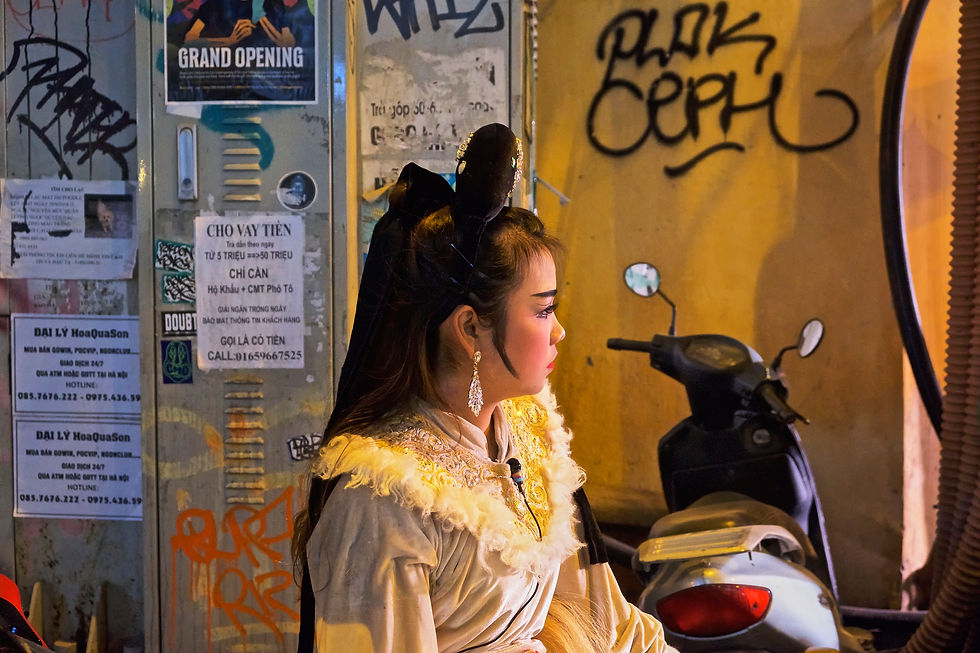
In Vietnam there are thriving and comprehensive street markets where individuals and families sell a comprehensive range of products and foods both day and night. Such markets occur wherever there is space to set one up and they cater for both locals and visitors. In Ha Noi hawkers drift through the narrow lanes of the Old Quarter selling snacks from traditional yoke baskets, motorbikes and cars weaving in and out between them, whilst advertising displays and strip lights illuminate the surrounding buildings.
Having arrived directly from Laos, Ha Noi was an assault on the senses; the noise, the smells, the bustle, the constant buzzing of the thousands of motorcycles, the kaleidoscope of vivid colours and subtle shades. All utterly compelling. Even outside of the capital there seems to be a continual busyness. The Vietnamese spend much time outdoors and everywhere and anywhere goods are being sold.
Whilst some images in this book show quieter reflection, taken particularly in the shade of the mountains in the North, most of the photographs are an attempt to encapsulate some of the sense of purpose, and enterprise of the people. Each image attempts to capture moments that can be viewed and understood individually, but contain a narrative in their own right. However, the photographs taken as a whole are intended to express a feeling of time and sense of place, and my experience observing the unfolding narrative.